
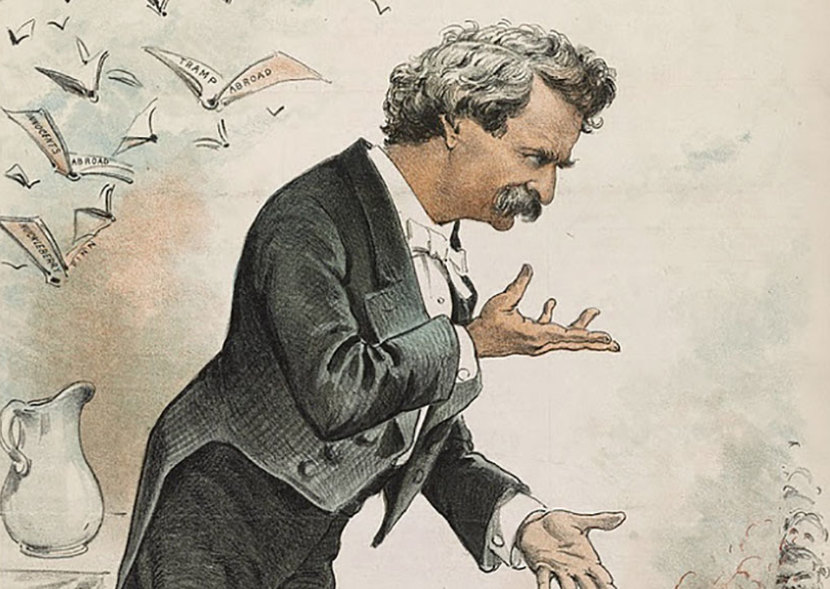
“At certain periods it becomes the dearest ambition of a man to keep a faithful record of his performances in a book; and he dashes at this work with an enthusiasm that imposes on him the notion that keeping a journal is the veriest pastime in the world, and the pleasantest. But if he only lives twenty-one days, he will find out that only those rare natures that are made up of pluck, endurance, devotion to duty for duty’s sake, and invincible determination may hope to venture upon so tremendous an enterprise as the keeping of a journal and not sustain a shameful defeat.”
—Mark Twain, Innocents Abroad (Ch. 4)
In 2008, David H. Fears would publish the first volume of Mark Twain Day by Day. It was no small task since Samuel Clemens was not a diarist and, although he wrote voluminous journals, they were sporadic at best at keeping note of the daily. To compile Mark Twain Day by Day, Fears used a broad array of primary sources, chief among them Clemens’s own words: his letters (including the Mark Twain Project’s editions and the earlier Mark Twain’s Letters), his notebooks and journals, his autobiographical dictations, and surviving manuscripts, along with contemporary newspapers and periodicals, both the papers Twain wrote for and dispatched to (the Alta California, Virginia City Territorial Enterprise, Buffalo Express, and others) and the press that covered his lectures, travels, and publications. Fears supplemented these with letters and diaries of family and associates (Olivia Clemens, Mary Mason Fairbanks, Joseph Twichell, among many others), business and legal records such as contracts, royalty statements, and account books, and public documents such as census returns and city directories.
For corroboration and more materials, Fears used a host of secondary scholarship—the standard biographies and critical studies by Albert Bigelow Paine, Dixon Wecter, Justin Kaplan, Hamlin Hill, Everett Emerson, Ron Powers, and Michael Shelden, among others, together with the scholarly apparatus of the Mark Twain Project—which he cites throughout in bracketed, abbreviated references keyed to those works. (See Works Cited)
Between 2008 and 2014, Fears would publish four large volumes. He used a small press he controlled (Horizon Micro Publishing) for this purpose. Later, he authorized its migration into freely accessible digital formats, which changed how Twain scholars could use the work.
Conception and Scope
Fears conceived Mark Twain Day by Day as an exhaustive, day-by-day annotated chronology of Samuel L. Clemens’s life. Volume I covers 1835–1885, and subsequent volumes extend through to the end of Clemens’s life. The four print works collectively track Twain’s movements, writings, business dealings, family events, and social engagements. Contemporary Twain scholars quickly treated it as a major reference tool, because it combined scattered data into one continuous framework.
In the end, Mark Twain Day by Day documents 13,716 distinct calendar days in Samuel Clemens’s life. This is roughly half (50%) of the 27,171 days he lived, from his birth on November 30, 1835, to his death on April 21, 1910. Those documented days are captured in approximately 14,419 date-anchored entry blocks, individual textual sections, each specifically labeled with a date or date range. There are slightly more entry blocks than days because some days are divided into multiple sub-entries, such as quoted dictations or letters, each having its own date marker. Together, the entries comprise about 2.8 million words. Each entry averages about 197 words, but the median is closer to 105. This shows a chronicle of mostly short daily notes with a long tail of multi-paragraph days. The dating is highly precise: 98% of entries are pinned to an exact single day, with only about 2% spanning a range, season, or month.
Print Publication and Reception
The books were printed on acid-free paper, given Library of Congress control numbers and ISBNs, and sold directly from the publisher, keeping them outside standard library acquisition channels. Because of their size and cost, the four volumes ended up mostly in university libraries and a few private collections. Institutions had excellent access, but individual researchers, teachers, and readers faced limited access.
While the nature and format of its publication did not lead to many full reviews in the academic and popular presses, review blurbs from Twain scholars stressed the “log” of Clemens’s life as both a useful chronology and an engaging read, noting its dense detail of daily life, business, and domestic matters.
Alan Gribben, for example, writes:
“More fascinating and far better documented than any existing biography of Mark Twain, this study provides a window into every waking—and for that matter, sleeping—moment of Twain’s hyperactive life. Many scholars before David Fears had contemplated undertaking this staggeringly daunting but incredibly useful project…. All students of Mark Twain should give heartfelt thanks for this masterful accomplishment. Fears interweaves even Twain’s most quotidian activities into a textured fabric, threading helpful explanations where needed. This book now qualifies as the single most essential reference work in Mark Twain scholarship. We will be indebted to David Fears forever.”
Digital Transformation and Wider Access
In 2019, the Center for Mark Twain Studies (CMTS) received Fears’s permission to create a digital version of Mark Twain Day By Day. The project turned the printed chronology into a searchable online edition. CMTS’s digital edition made the entire chronology freely available to “Twain scholars, teachers, students, hobbyists, and all varieties of Twainiacs.” This considerably broadened access to a previously scarce print resource.
Ongoing Use in Twain Studies
By the mid-2020s, multiple CMTS initiatives, such as “Mark Twain Day By Day – 150 Years Ago,” explicitly build serialized online features out of Fears’s chronological entries, repackaging them in blog-style narratives keyed to specific dates. These projects treat Day by Day as a basic research work that can be selectively surfaced for public history, pedagogy, and scholarly commentary. Fears’s work illustrates how an independently conceived reference project can become, through digital transformation, a mainstay of contemporary Twain scholarship and infrastructure.
One auspicious example of what can be done with Fears’s Day by Day is B. Scott Holmes’s Twain’s Geographies (https://twainsgeography.com/). Twain’s Geographies is an independent, born-digital scholarly project that reconstructs and maps Samuel Clemens’s lifelong travels, using narrative episodes, timelines, and transportation networks, especially railroads, to explore his movements within the broader history of industrialization and modern mobility. The site’s core goal is to document “Mark Twain as traveler,” linking places visited, routes taken, and modes of transport to the economic and technological transformations of the nineteenth-century United States and beyond.
Twain’s Geographies builds on David Fears’s Mark Twain Day by Day by turning Fears’s exhaustive chronological log of Clemens’s life into a spatially and infrastructurally oriented project, emphasizing routes, places, and transportation systems rather than only daily events. Fears’s work provides a comprehensive, date-by-date narrative and reference framework: four large volumes of annotated chronology—which Twain’s Geographies explicitly adopts as a “time-line solution” to anchor its episodes and epochs. Where Fears focuses on what Twain was doing on particular days, Twain’s Geographies reorganizes and visualizes that biographical data around travel, geography, and railroads, layering maps, Google Earth railroad overlays, and transport modes onto Fears’s chronology to show how Twain’s movements intersect with the development of modern transportation and global mobility. In that sense, it augments Fears by (1) geotagging and mapping journeys, (2) grouping days into travel “episodes” and historical “epochs,” and (3) inviting ongoing digital curation and correction, while continuing to rely on Day by Day as the underlying temporal scaffold rather than duplicating Fears’s biographical research.
Reviving / Renewing the Digital Version of Mark Twain Day By Day
In 2024, as part of a larger viral attack, the Center for Mark Twain Studies needed to take the digital version of Mark Twain Day By Day offline. As part of bringing it back online, the CMTS engaged with the noted Twain scholar, Stephen Rachman and Matrix, the Center for Digital Humanities and Social Sciences at Michigan State University. See Workshop Overview.
Project Personnel
Joe Lemak: He is the Director of the Center for Mark Twain Studies at Elmira College. He acquired the digital rights of Mark Twain Day by Day for Elmira College from David Fears. Along with Stephen Rachman, he has been part of the project since its inception and secured funding from Susan Jaffe Tane. He is a liaison to the Mark Twain Studies academic community and organizes the logistics of the Mark Twain Day by Day workshop and quadrennial conference.
Stephen Rachman: He is the former Director of the American Studies Program and former Co-Director of the Digital Humanities and Literary Cognition Laboratory at Michigan State University.He is the editor of The Hasheesh Eater by Fitz-Hugh Ludlow (Rutgers University Press). He is a co-author of the award-winning Cholera, Chloroform, and the Science of Medicine: A Life of John Snow (Oxford University Press), co-editor of Chinese Women Writers on the Environment: A Multi-Ethnic Anthology of Fiction and Nonfiction (McFarland) and the co-editor of The American Face of Edgar Allan Poe (Johns Hopkins University Press). He has written numerous articles on Poe, literature and medicine, cities, popular culture, and an award-winning Web site on Sunday school books for the Library of Congress American Memory Project. He is a past president of the Poe Studies Association and currently completing a study of Poe entitled The Jingle Man: Edgar Allan Poe and the Problems of Culture.In 2003, Rachman completed a tour of India through the U.S. Department of State Speaker’s Bureau, lecturing on American studies, globalization, and peace. He was the 2003–04 William S. Vaughn Visiting Fellow at the Robert Penn Warren Center for the Humanities at Vanderbilt University. He worked at the humanities center as part of the medicine, health, and society group on a study of a remarkable series of nineteenth-century paintings by a highly regarded Cantonese export artist known as Lam Qua. The paintings depict the Chinese patients of a leading medical missionary—Reverend Dr. Peter Parker, an American Presbyterian minister and physician who opened a hospital in Canton in the 1830s.He is a recipient of the 2007 AT&T Faculty Instructional Technology Award, First Place. Blended Course. He is a research associate with the Melville Electronic Library Group developing an online version of Herman Melville’s Civil War Poetry Battle-Pieces. Most recently, with Natalie Phillips he is collaborating on several neuro-literary projects including an essay for a forthcoming collection Humanities and the Digital (MIT Press) edited by David Theo Goldberg and Patrick Svensson, entitled, “Reshaping Fields through Intersecting Technologies from Literary Neuroscience and Digital Humanities.”In 2012-13, he began a project on Pearl S. Buck as a transnational Sino-Ameican figure exploring the her concepts of comparative democracy, feminism, and literature. In 2023, he was a fellow at Quarry Farm, Mark Twain’s summer home. For his reflections on that experience: https://marktwainstudies.com/quarry-farm-testimonials/the-mirror-of-your-imagination-a-quarry-farm-testimonial/
Gillian McDonald:
Dean Rehberger: He is an Associate Professor of History at Michigan State University and a digital historian whose work centers on large-scale digital humanities infrastructures and data-rich research environments. His scholarship and project leadership span digital history, GLAM stewardship, oral history, and the semantic web, with recent work focusing on AI, knowledge graphs, and interoperable, provenance-rich data for humanities research.
Alicia Sheill: She is Head of Operations at MATRIX: The Center for Digital Humanities & Social Sciences, where she brings over twenty years of experience in project and data management to the development of major digital humanities initiatives. She has led the creation of numerous internationally recognized digital projects, including America in the Kitchen, the Archive of Malian Photography, Digital Canterbury, Enslaved: Peoples of the Historical Slave Trade, Mark Twain Day-by-Day, The Quilt Index, Seventeen Moments in Soviet History, and What America Ate—work supported by funding from the Lilly Endowment, the Mellon Foundation, the National Endowment for the Humanities, the National Science Foundation, and the Terra Foundation. Sheill brings deep expertise in metadata standards, semantic technologies, and ontology development, with a particular focus on the publication of linked open data and knowledge graphs, as well as data remediation and integration.
Catherine Foley: